Design and Construction of Efficient and Cost-Effective Solar Dryers for Low and Medium-Size Farmers and Food Processing Enterprises in Rwanda
Open-air sun drying is one of the oldest methods for preserving agricultural products. But this method has many limitations including: the dependence on ambient conditions and being prone to contamination by dust, rain, wind, pests, and rodents; and the cost of a standby manpower for transportation in case of interruption by changes in weather conditions. Reviews have shown that poor infrastructure for storage, processing and marketing in many countries results to a high proportion of waste, which average between 10 and 40 % and can reach 30 % in Rwanda. Due to the rise of fuel prices, depletion of fossil fuels, and the issue of air pollution; the use of modern drying technologies is not economical for drying agricultural product. We propose a research to promote in-house solar drying technologies as an eco-friendly method to reduce postharvest losses, improve the quality of dried food, and minimize the cost of postharvest processing in Rwanda.
Solar dryers are simple boxes working under the greenhouse effect. Nevertheless, for decades, this technology has been relying on empirical and artisanal knowledge. As results, the large scale deployment of the technology has only been successful in countries where the try-and-error method can work; where the cost of essential materials is very low or enough design data are already available. To have the technology adopted in Rwanda, scientific understanding of the process should lead to optimized designs with high efficiency, low cost, and durable; customized for a specific region in the country and for a specific crop product. This project intends to put together efforts from a diverse team to combine the study of the physics of solar energy collection, the process of humidity reduction in the crop, the effect on food nutriment, and the strength and durability of alternative material used; to propose the appropriate designs for specific applications in various regions across Rwanda.
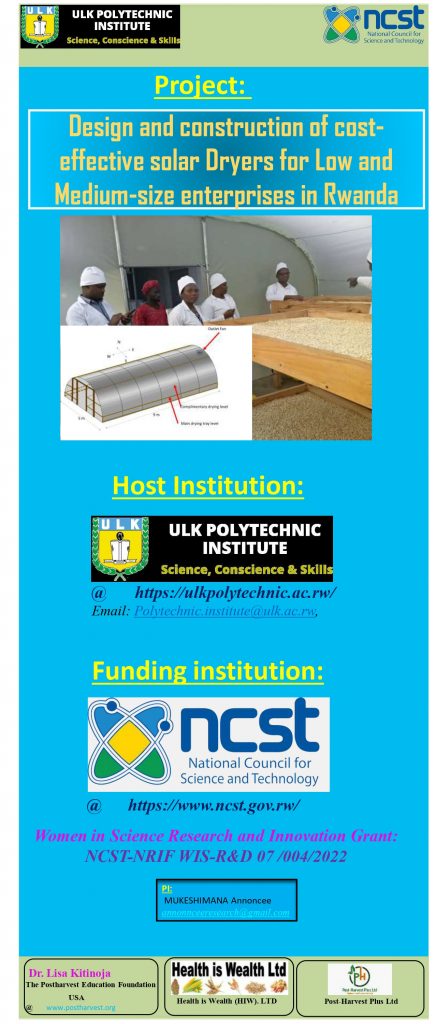
A team from ULK Polytechnic institute, made of investigators from Science and Engineering background, are collaborating with food science and postharvest expert from postharvest Plus Ltd, a global expert in postharvest handling, and a local food processing company in the project. They are working together to propose solutions for the issues hindering the use of the technology including the high capital investment, long payback period and lack of confidence in the technology. It is expected that at the end of the project implementation, an academic and business platform will have been built to provide cost-effective, efficient, and good quality designs; and construction works for customized solar dryers. Through the project, prototypes are constructed in Bugesera ant the Health is wealth facility and at Gisozi on ULK premises. Design simulation App are developed in COMSOL Multiphysics software to easy the design process.