NDIKUMANA Venuste

NDIKUMANA Venuste

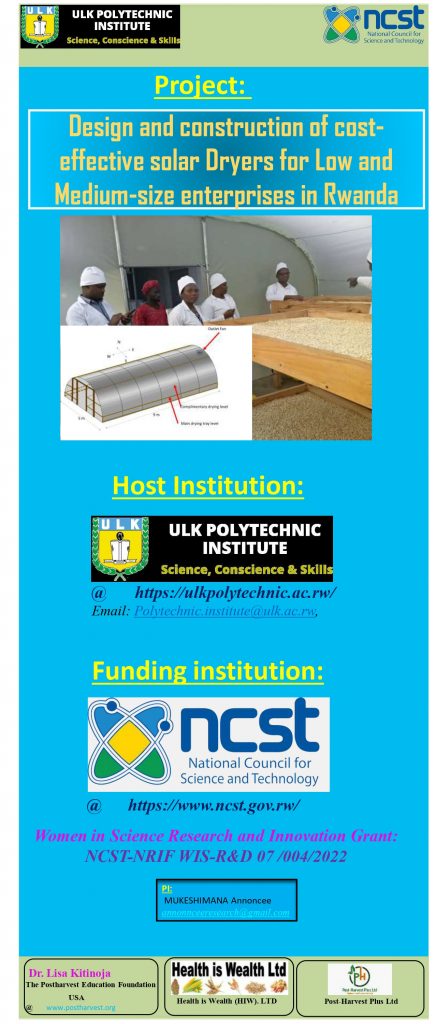
Design and Construction of Efficient and Cost-Effective Solar Dryers for Low and Medium-Size Farmers and Food Processing Enterprises in Rwanda

Open-air sun drying is one of the oldest methods for preserving agricultural products. But this method has many limitations including: the dependence on ambient conditions and being prone to contamination by dust, rain, wind, pests, and rodents; and the cost of a standby manpower for transportation in case of interruption by changes in weather conditions. Reviews have shown that poor infrastructure for storage, processing and marketing in many countries results to a high proportion of waste, which average between 10 and 40 % and can reach 30 % in Rwanda. Due to the rise of fuel prices, depletion of fossil fuels, and the issue of air pollution; the use of modern drying technologies is not economical for drying agricultural product. We propose a research to promote in-house solar drying technologies as an eco-friendly method to reduce postharvest losses, improve the quality of dried food, and minimize the cost of postharvest processing in Rwanda. 

Solar dryers are simple boxes working under the greenhouse effect. Nevertheless, for decades, this technology has been relying on empirical and artisanal knowledge. As results, the large scale deployment of the technology has only been successful in countries where the try-and-error method can work; where the cost of essential materials is very low or enough design data are already available. To have the technology adopted in Rwanda, scientific understanding of the process should lead to optimized designs with high efficiency, low cost, and durable; customized for a specific region in the country and for a specific crop product. This project intends to put together efforts from a diverse team to combine the study of the physics of solar energy collection, the process of humidity reduction in the crop, the effect on food nutriment, and the strength and durability of alternative material used; to propose the appropriate designs for specific applications in various regions across Rwanda. 

A team from ULK Polytechnic institute, made of investigators from Science and Engineering background, are collaborating with food science and postharvest expert from postharvest Plus Ltd, a global expert in postharvest handling, and a local food processing company in the project. They are working together to propose solutions for the issues hindering the use of the technology including the high capital investment, long payback period and lack of confidence in the technology. It is expected that at the end of the project implementation, an academic and business platform will have been built to provide cost-effective, efficient, and good quality designs; and construction works for customized solar dryers. Through the project, prototypes are constructed in Bugesera ant the Health is wealth facility and at Gisozi on ULK premises. Design simulation App are developed in COMSOL Multiphysics software to easy the design process.
Read More

ULK Polytechnic Institute Students Master Electric Motorcycle Retrofitting

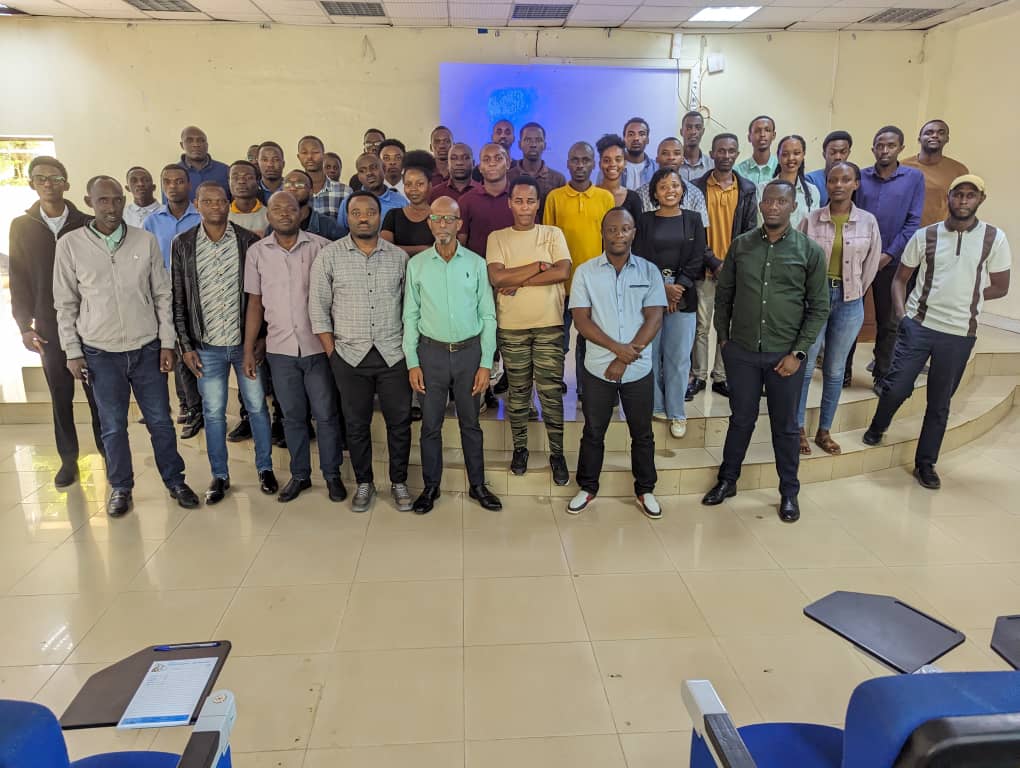
Kigali, June 23, 2025 – Students from ULK Polytechnic Institute came together at the UR–CST Campus for a one-day training focused on transitioning internal combustion engine (ICE) motorcycles to electric powertrains. The training organised by UR/College of science and Technology, Rwanda Electrical Motors Ltd (REM) and National Council of Science and Technology (NCST), empowered participants with rapidly evolving e‑mobility skills. Major highlights captured included: core e‑mobility concepts, comprehensive component knowledge, safety and maintenance protocols, environmental & socio-economic insights.

UPI students and other participants in a group photo

The course concluded with a discussion on how e-mobility supports environmental health, public well‑being, and economic opportunity.
By the end of the workshop, students and other participants had mastered core principles of electric powertrains, developed side-by-side comparisons with ICE motorcycles, attained essential safety competencies for high-voltage systems and gained insights into the environmental, health, and socio-economic impacts of e‑mobility, Twahirwa Marie Martine, a year 3 construction technology student at UPI reflected, “Understanding how to convert and maintain electric bikes gives me the tools to drive sustainable transport in our communities.”

This initiative marks a significant milestone for both ULK Polytechnic Institute and Rwanda’s transition toward e‑mobility. Graduates equipped with retrofitting and technical skills will help scale locally driven solutions in green transportation, fueling jobs, cleaner air, and climate-smart innovation.

As a hub of technical education and innovation, ULK Polytechnic Institute aims to prepare students to lead in sustainable technologies. With practical training such as this, the institute remains at the forefront of equipping graduates to shape Rwanda’s green economy.

Read More

ULK POLYTECHNIC INSTITUTE WINS RWANDA’S NATIONAL COUNCIL FOR SCIENCE AND TECHNOLOGY (NCST) RESEARCH GRANT TO REVOLUTIONIZE SOLAR DRYING FOR RWANDAN FARMERS

In a groundbreaking achievement, ULK Polytechnic Institute has been awarded a significant research grant by the National Council for Science and Technology (NCST) to spearhead a project titled “Design and Construction of Efficient and Cost-Effective Solar Dryers for Low and Medium-Size Farmers and Food Processing Enterprises in Rwanda.” The research grant, numbered NCST-NRIF WIS-R&D 07 /004/2022, amounts to Frw 90,000,000 and is set to unfold over a three-year period.

The research project aims to address the challenges associated with traditional open-air sun drying methods, which are prevalent in Rwanda. These methods are hindered by their dependency on ambient conditions, susceptibility to contamination, and the need for standby manpower to intervene in changing weather conditions. The initiative seeks to introduce in-house solar drying technologies as an eco-friendly solution to reduce postharvest losses, enhance the quality of dried food, and cut down on the cost of postharvest processing.


ULK Polytechnic Institute, in collaboration with postharvest experts from Postharvest Plus Ltd and a local food processing company, plans to study the physics of solar energy collection, humidity reduction in crops, and the impact on food nutrients. The research team, led by Principal Investigator Eng. Mukeshimana Annoncée, will employ design simulation and optimization using software tools such as COMSOL Multiphysics. Drying conditions data will be collected across different locations in Rwanda to propose customized and efficient designs for specific applications.


Upon completion of the project, the team anticipates establishing an academic and business platform that provides cost-effective, efficient, and high-quality designs and constructions of customized solar dryers. The outcomes include construction demonstrations across the country, a regional database of design parameters, and the development of a design simulation app to streamline the design process.

Research Team:

Eng. Mukeshimana Annoncee serves as the Principal Investigator, leading a diverse team comprising Co-Principal Investigators Dr. Habimana Jean Willy, Eng. Karikurubu Emmanuel, Ms. Nyirahafashimana Valentine, and Mr. Amani Manzi Alain. Collaborators include experts from Post-Harvest Plus Ltd, the Postharvest Education Foundation (PEF), and Health is Wealth Ltd, contributing their knowledge and expertise to ensure the success of the project.


The research team expressed gratitude to NCST for organizing the contest and recognized the importance of promoting women in research. As the project progresses, regular updates and physical meetings, including a recent one at NCST Office, demonstrate the commitment of ULK Polytechnic Institute and NCST to collaboratively advancing the research and implementation of solar drying technologies in Rwanda.


This research project stands as a testament to the institution’s commitment to scientific innovation, environmental sustainability, and contributing to the socio-economic development of Rwanda.

Read More